
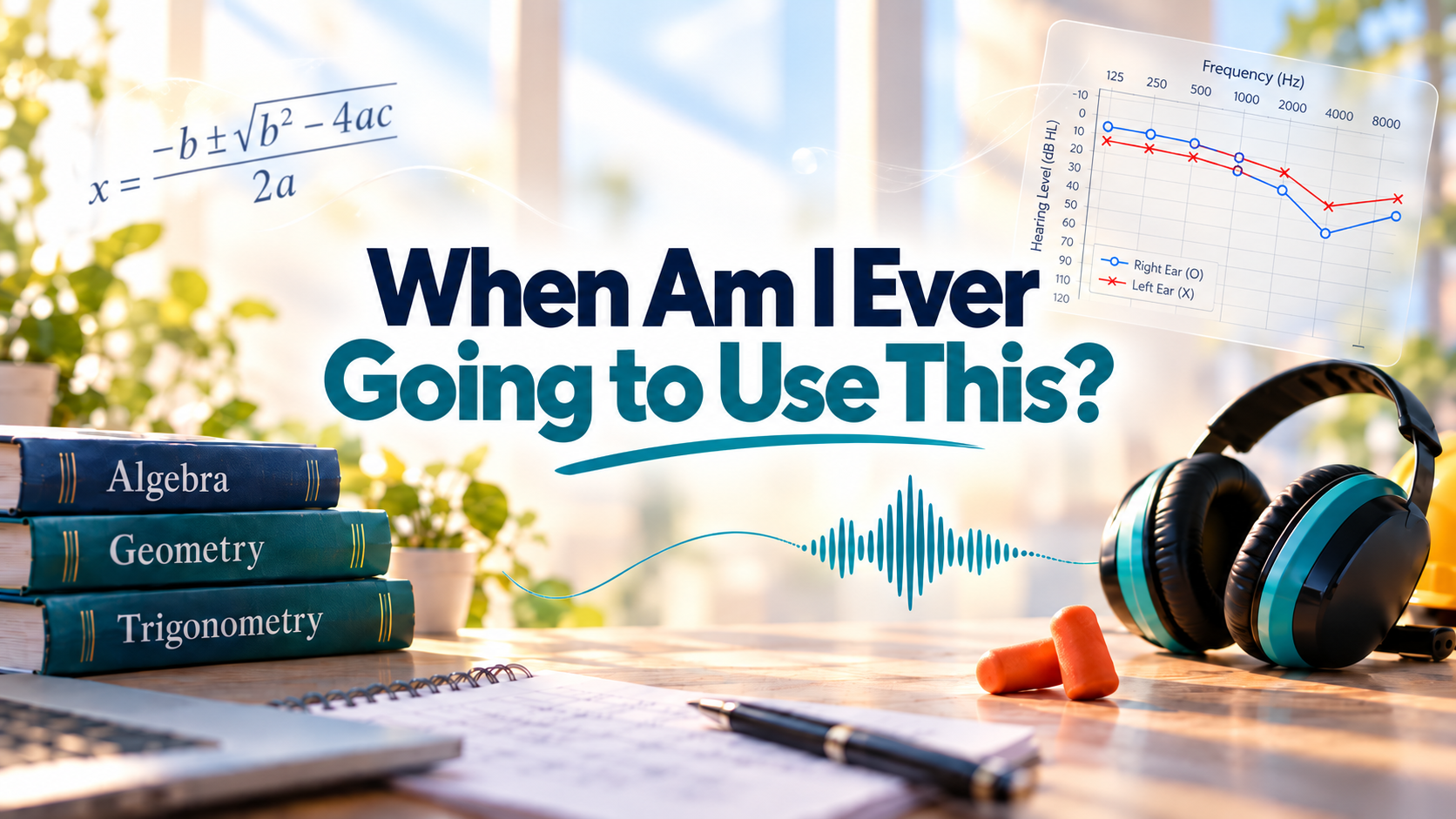
Before joining the Occupational Sound Solutions team in January, I spent most of my career in a very different setting: teaching middle and high school math. Which means I spent a lot of years answering one particular question.
“When am I ever going to use this?”
If you have memories of sitting in a math classroom wondering why anyone thought you needed to know how to solve for x, you may have asked it yourself. As a teacher, I heard it constantly. Sometimes it was asked with genuine curiosity. Other times it came with the unmistakable tone of a teenager who was quite certain that whatever we were discussing would have absolutely no relevance to the rest of their life.
Either way, there was an important question underneath it: Why does this matter to me?
Over the years, I learned that answering that question mattered more than I initially realized. I could explain the concept. I could model it step by step. I could draw a picture, use different colors, try another example and ask, “Does that make sense?” I might even get a classroom full of nodding heads. Success!
Or so I thought.
Then we would come back the next day, and it would sometimes feel as though we had never discussed it in the first place. The information had gone in one ear, made perfectly good sense in the moment, and then gone right back out the other.
And yes, I appreciate the irony of that expression a little more now that I work in hearing conservation.
New Information Needs Somewhere to Land
One of the challenges of being the person who already knows something is that it can be easy to forget what it feels like NOT to know it.
When I looked at a math problem, I wasn’t just seeing the problem in front of me. I was drawing on years of knowledge, patterns, rules, and experiences that helped me make sense of it. My students didn’t necessarily have all of those connections yet.
It turns out there’s a reason those connections matter. One of the ways in which we make sense of new information is by relating it to things we already know. Prior knowledge gives new ideas a framework—a place to fit. When those connections are limited, learning can take more time. In other words, new information needs somewhere to land. I understood that from years of teaching. Then I changed careers and got a very good reminder of what it feels like when there is nowhere for the information to land.
The world of hearing conservation was a door I didn’t even know existed, much less one I ever imagined I would walk through. One of my first steps through that door was taking my CAOHC certification course. And suddenly, I was the student.
Audiograms. Baselines. Standard threshold shifts. Noise exposure. Hearing protection. Regulations. Professional Supervisors. And acronyms—so many acronyms! It was an entirely new vocabulary attached to an entirely new field. I could listen to an explanation and think, Okay, that makes sense. But I had almost no background knowledge to connect it to. For the first time in a long time, I was reminded of what it felt like to sit on the other side of the classroom.
There was one important difference, though. I knew exactly why I needed to learn it.
Part of my role at OSS would be helping people use technology designed to support their hearing conservation programs. I would be teaching clients how to use our platforms, answering questions, and helping them understand how those tools fit into the larger picture of their HCP.
If I was going to do that well, I needed to understand more than which button to click. I needed to understand why they were clicking it. That was my connection. My answer to, “When am I ever going to use this?” was pretty much immediately.
And that experience changed the way I thought about the question.
You see sometimes we can connect new learning to something a person already knows. But sometimes the learner doesn’t have much background knowledge yet. In those moments, the first connection may simply be purpose.
Why does it matter if I don’t wear my hearing protection correctly?
Why do I need a hearing test every year if my hearing seems fine?
Why should I care about a change in hearing if I haven’t noticed one myself?
Those questions are really different versions of the same question my math students used to ask: Why do I need to know this?
And that is worth answering.
Knowing the “why” doesn’t make unfamiliar information instantly easy. But it gives the learner a reason to pay attention, connect the information to their own experience and keep working with it long enough for more connections to develop.
Learning Takes More Than One Encounter
I didn’t walk out of my CAOHC course suddenly fluent in hearing conservation. I walked out with a good foundation. Then I kept encountering the information. I saw audiograms. I worked in OccuSound® Nexus. I listened to questions from clients. I heard Sarah explain situations. I worked on educational materials. Concepts that had originally existed mostly on slides and in a manual started showing up in actual situations.
And every time they did, I had a little more context than I had the time before. Something I vaguely remembered from class suddenly had a real example attached to it. A term that once sounded foreign became familiar. One piece connected to another. Eventually, I wasn’t trying to remember a collection of isolated facts anymore. I was beginning to understand how they worked together.
That experience reflects something learning research has shown repeatedly: information is more likely to stick when we return to it over time and when we actively recall and use it, rather than simply hear it once. It’s the same reason why you can remember the lyrics to a song you learned 15 years ago but forget what’s on the grocery list you wrote this morning.
And what that means is that the need for repetition doesn’t mean someone “didn’t get it” the first time. Repetition is often HOW we get it, because each time we approach the new learning we bring something new with us. The learner we teach something to the second or third time isn’t exactly the same learner who heard it the first time. Now they may have an experience to connect it to. They may have seen the concept in practice. They may finally have the context that wasn’t there before.
But eventually, we have to do more than recognize the information. We have to use it. That might mean interpreting something, answering a question, practicing a procedure, explaining an idea to someone else, or making a decision based on what we know.
That’s where knowledge begins to become competency.
And it isn’t always neat.
We forget things. We ask questions. We look things up again. We discover that something we thought we understood has a few more layers than we realized.
I certainly have. But that isn’t failure. That’s learning.
What This Changes
My career has given me the unique experience of moving from teacher, to complete beginner, and—in many ways—back to educator again.
Teaching math taught me how hard it can be to create meaningful connections for learners.
Learning hearing conservation reminded me how it feels when those connections don’t exist yet.
And both experiences have changed the way I think about education, including the way I approach it at Occupational Sound Solutions. Whether we are training an employee, educating an OHC, helping a client understand hearing conservation data, introducing a new process or showing someone how to use a platform, simply presenting the information isn’t the same thing as creating learning.
We have to help people understand why it matters.
We have to connect new information to something familiar whenever we can.
We have to expect that important ideas will need repetition.
We have to give people opportunities to actually use what they’ve learned.
And we have to have a little patience with the person who doesn’t understand something yet.
Once we know a subject well, the terminology becomes familiar. The relationships seem obvious. We make connections automatically. The learner may not be there yet. Sometimes they don’t need another slide or the exact same explanation one more time.
They may need more context.
They may need another encounter with the idea.
They may need a chance to use it.
Or they may simply need help answering the question my students asked me for years:
“When am I ever going to use this?” I used to consider that to be the question every math teacher dreaded. Now I think it may be one of the most important questions we can help a learner answer.